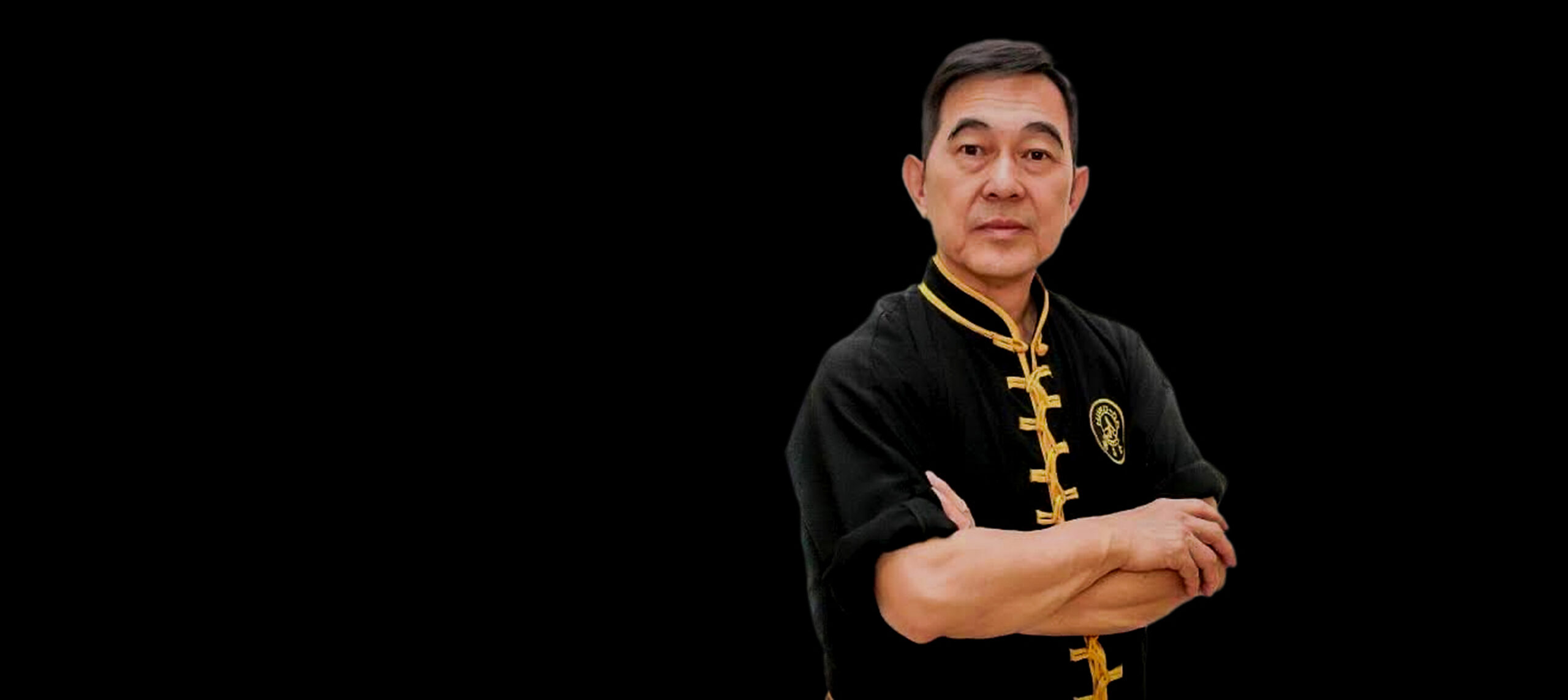
Grandmaster Frank Yee (余志伟)
Achieving greatness through strong will· Journeying from East to West,
firmly establishing a root from which a thriving lineage would rise.
Grandmaster Frank Yee (余志伟) (Yee Chee Wai), the Founder of Yee’s Hung Ga International Kung Fu Association, was born on July 28, 1951, and began his early Kung Fu training with his father at the age of six. He later started his formal Tang Fong (邓芳) Hung Ga training under the tutelage of Great Grandmaster Yuen Ling (阮凌). Grandmaster Yee immersed himself in his Hung Ga training, studying intensively and diligently under the watchful eye of his Sifu. After many years of dedicated study, he was rewarded with the Bai Si ceremony and became a disciple of his Sifu. Of all the disciples of Great Grandmaster Yuen Ling, only Grandmaster Frank Yee has dedicated his life to teaching Tang Fong Hung Ga Kung Fu.
Before leaving Hong Kong, Grandmaster Yee found the time to learn from his brother, Yee Sihk Tim, a practitioner of the Bak Hsing Choy Lee Fut system created by Grandmaster Tam Sam (谭三). He learned the “Continuous Piercing Hammer Fist” / Lin Wan Chop Choi (连环插搥), a great attacking technique, as well as the mouse-stepping patterns. He also found the time to learn some Northern Shaolin from his other brother, Albert Yee.
In 1968, Grandmaster Yee emigrated from Hong Kong to Montreal, Canada, and soon after went to George Brown College in Toronto, where he earned a Mechanical Engineering degree. During this period, he taught Hung Ga Kung Fu at the college, the Jong Ting Association, and the Hung Moon Association (known as the Chinese Freemasons), as well as working and studying for his degree. He met and became close friends with Master Lore (Loh) King Hung (罗景雄) (James Lore) of the Village Hung style. Master Lore shared and taught him one of his specialties: the methods of shifting and moving with solidity and speed. He also learned the Elbow Cover Blade method of the Butterfly Knives, which Grandmaster Frank Yee added into his “Mother Son Double Knives” / Ji Mo Seurng Dao form. Many stories of the exploits of Grandmaster Yee and his students from those early years in Canada are still told today. These moments, when Frank Yee and his students helped bring peace and justice to the community, have become legends of the past.
In 1973, Grandmaster Yee arrived in New York City’s Chinatown to be reunited with his aging medicine teacher, Doctor Sit Chuek Sing (薛桌圣), a doctor famed for his healing skills and whose family was renowned for having been personal physicians to the Ching Emperors of China for four generations. Doctor Sit was also known as one of the four famous doctors of Hong Kong. Grandmaster Yee continued his studies of Dit Da and herbal medicine during this time, assisting in running his Chinatown clinic. He also learned internal medicine from his teacher’s son, Dr. Sit Chiu Wai (薛超伟).
Grandmaster Frank Yee decided to stay and teach in New York City, and therefore established Yee’s Hung Ga Kung Fu Academy. His teachings quickly became a sought-after practice; his students performed in demonstrations and often competed, winning numerous championships. He soon became a familiar name amongst the New York Chinatown greats. His Lion Dance skills were also in high demand, leading him to share them with many notable Kung Fu associations. As well as teaching in his school, Grandmaster Yee found the time to teach at Long Island University, Columbia University, and Hunter College.
Grandmaster Frank Yee was one of the founders of the Eastern United States Kung Fu Federation and has served as its President, Vice-President, and Secretary. He became an avid supporter, protector, and eventually Vice-President of the Chinese Staff and Workers Union in Chinatown, attending many of their rallies with students and providing security and protection for the workers if situations arose. On one such occasion, he and his students were asked to attend the Union rallies for the fair treatment of restaurant employees. They were expecting trouble, and when trouble appeared, Grandmaster Yee dispatched his students to end the threat. These occasions became commonplace during the turbulent Chinatown years, as he was called upon to help different organizations in times of need.
During the early 1980s, he was introduced to Master Kwan Tak Hing (关德兴), the renowned movie actor and humanitarian. It was from Master Kwan that Grandmaster Yee learned Crane Qigong, as well as his specialty: the six-and-a-half point long pole techniques, for which Master Kwan Tak Hing was famous. He also studied Buddhist meditation with him, and their relationship was such that Master Kwan often treated Grandmaster Yee as a close friend. Frank Yee, however, had too much respect for him and considered him a teacher. Master Kwan Tak Hing bestowed upon him two couplets of calligraphy: one read “To clean the name of the Sick Men of Asia,” and the other, “His skills are Number One.” Grandmaster Yee later donated the first couplet to the Wong Fei Hung Museum in Foshan, People’s Republic of China, where it proudly hangs today.
Grandmaster Frank Yee met his Sisook Jyu Yuen Ming (朱願明), who had recently moved to New York City’s Chinatown. He was a student of Grandmaster Tang Fong, as well as the famous Tai Chi Grandmaster Cheng Ting Hung, whose fighters were renowned for winning numerous platform matches (Lei Tei) in Hong Kong and Taiwan. Master Cheng was also famous for a set called the “Yin and Yang Method of Tai Chi Gong,” a set of Qi Gong exercises that develop incredible Ging and an amazing ability to receive blows. He learned these exercises from Sisuk Jyu Yuen Ming, and later travelled with him to do some additional training with Cheng Ting Hung himself. Grandmaster Yee teaches the Yin portion of the exercises to his students, as he believes this part to be a better fit for them and therefore to have the greatest benefit.
In 1984, Grandmaster Frank Yee was invited to be a part of a special Kung Fu delegation organized by the Chinese government for an exchange of knowledge. This trip took him across China to the Shaolin Temple and to Taishan (台山), the birthplace of his father. He was saddened by the poor conditions that existed there, and a seed was planted that was to bear fruit exactly one decade later. After the passing of his father, Grandmaster Yee often wondered what he could do in memory of his father and the family name. He thought about building a park for children to play in, or a monument, but the decision was slow in coming. In 1994, after a series of life-changing events, Frank Yee had the opportunity to spend nine months in Taishan. During this time, he immersed himself in his Hung Ga training and began teaching Wong Fei Hung’s Traditional Hung Ga Kung Fu to the elderly. Even though the students were of an advanced age, they worked hard and longed for more of the traditional teachings. This led him to move to Taishan and establish a lineage there: he would teach for free and give something back to his father’s city.
It was also during this time that he established new personal goals and created the Taishan City Toi Sing Kung Fu Association, where he still teaches traditional Hung Ga Kung Fu and Lion Dance. Grandmaster Yee accepted only those students who showed a commitment to learning and who were of high moral fiber. He provided living quarters, equipment, and training to his students free of charge. Through his school, he worked to revive traditional Southern Kung Fu in China in the face of the onslaught of Wushu. It is due to his dedication that the people of Southern China are being reintroduced to traditional Kung Fu and are embracing it once again. At the request of the Taishan City government in China, he currently presides over the Taishan Kung Fu Association, overseeing martial arts activities for the city of Taishan. Frank Yee also serves as an advisor to the Wong Fei Hung Museum in Foshan, and as the coach of the museum’s Traditional Kung Fu Division.
During his interactions in China, Grandmaster Frank Yee helped to promote the first traditional Kung Fu championships in Guangdong province. The practitioners paid an entrance fee, which was unheard of in China at the time. The popular consensus was that people would never be interested if they had to pay, but they soon found themselves overwhelmed by over five thousand competitors. They had to arrange regional championships in different parts of the province to handle the enormous turnout, culminating in a final event to determine the winners. Grandmaster Yee’s students placed first in many events, as well as becoming the Lion Dance champions of Guangdong. The name of Yee’s Hung Ga International Kung Fu Association and the Taishan City Martial Arts Association was now firmly established in Southern China.
While on one of his visits to Hong Kong, Grandmaster Yee was introduced to Shaolin Monk So Jan (素真大师), a 103-year-old 38th-generation successor of the Shaolin Temple. He graduated and left the Northern Shaolin Temple to travel south in 1922. Monk So Jan is believed to be the last living fully graduated monk from before the Northern temple was burned down in 1929. Frank Yee began spending time with him and established a friendship. Monk So Jan later asked Grandmaster Yee to help him rebuild the original Fukien Po Til Southern Shaolin Temple on the grounds where it had actually once stood. After visiting his family, Monk So Jan met some of the surviving monks of the Southern temple and trained with them on the original grounds, where they continued to practice in the ruins. He was therefore considered a successor to both the North and South Shaolin temples, as proven by his possession of the Green and White Jade Seals (Chops), gifted to the temples by a Tang Dynasty Emperor. Supported by members of the present-day Northern Shaolin Temple and Grandmaster Yee, Monk So Jan met with the government officials and, after pleading his case, was given a parcel of land near, but not on, the original grounds. As a gift of appreciation, Monk So Jan donated one of the seals to be placed in a museum. He appointed Grandmaster Frank Yee as the 2nd Advisor to the new Southern Shaolin Temple, which was shortly to be built.
On returning to the United States, Grandmaster Yee wanted to reignite the flames of traditional Kung Fu and therefore honored the name of Great Grandmaster Wong Fei Hung by inaugurating the Wong Fei Hung Northeastern All Kung Fu Championship tournament in 1996. This annual tournament grew each year, attracting over 500 competitors from all over the United States, Canada, Europe, South America, and Asia. It held over 136 divisions, including Traditional Kung Fu, Modern Wushu, Shuai Jiao, Internal Styles, Fighting, Chi Sao, and Push Hand events, and ran for 13 consecutive years.
In 2001, Grandmaster Frank Yee wished to introduce his American disciples to Taishan and bring the whole family together. When word spread of the possible visit, he was asked to have a friendly meeting and a no-holds-barred exchange of skills with the Foshan Ching Woo Association (佛山精武会). It was requested that some of their fighters meet some of his. Grandmaster Yee immediately agreed and called upon his senior disciple and adopted son, Master Pedro Cepero Yee, to prepare fighters for the event. When the family arrived from the USA, they performed across Hong Kong for their uncles and Si Tai Pau, in Foshan at the Wong Fei Hung Museum, and then in the Taishan Sports Arena. This arena has 3,500 seats and was filled to capacity, and there were between 6,000 and 8,000 more people trying to push their way in to see the performance. Government officials could not get through, and so the military was called in to clear a path, as the event could not start without them. This was even more impressive considering Taishan City is one of the oldest martial arts towns in China; to hold audiences’ attention there requires a high-level demonstration of skill. Grandmaster Yee’s show captivated the audience and received a standing ovation after over three hours of Kung Fu performances. It was astounding — the level of skill had now been demonstrated, and Yee’s Hung Ga gained new-found respect across the world in the international martial arts community, as well as in its birthplace. The final stop would be the exchange at the Ching Woo Association. Up to this point, all the demonstrations had been aired on national television. When the team arrived, they were asked to exchange as friends, with no need for a physical confrontation, to show unity to the world, which would have a greater effect on the martial arts community. Stronger ties with the Ching Woo Association were therefore established, and they would work together in the future to promote traditional values and systems.
Grandmaster Frank Yee has made many friends in the Martial Forest in China who contributed to his growth. Mr. Gong Wuen (龚焕), for instance, gave Grandmaster Yee access to many rare and ancient martial and military arts manuals in the government libraries for at least eight hours a day. This allowed him to gain insight into the beginnings of many weapons’ usage, fighting arts, as well as actual battlefield records: military and martial strategies that were used in past wars. This helped improve Grandmaster Yee’s views on many aspects of martial and military arts.
Another friend of over twenty years was 94-year-old Grandmaster Chan Wing Yan (陈荣恩) (Chen Rong En) of the Fut Ga Style (佛家拳). He was a disciple of the Great Grandmaster Leung Ting Chiu (梁天柱), the creator of the Flying Dragon Pole (飞龙棍) and the Fut Ga systems. Their friendship grew so close that Grandmaster Chan Wing Yan stated that they should become blood brothers. Grandmaster Yee had too much respect for him, though, and regarded him more as a teacher. Frank Yee learned pole and empty-hand techniques from Grandmaster Chan Wing Yan, who put the pole and hand methods of the system on DVD for Grandmaster Yee to preserve a historical record. Grandmaster Yee’s pole techniques therefore blend the teachings of three teachers: Great Grandmaster Yuen Ling, Master Kwan Tak Hing, and Grandmaster Chan Wing Yan.
Over the last decade, Grandmaster Frank Yee has appeared in numerous documentaries and many national and international magazines, as well as featuring on magazine covers. He is well known in China for his episodes of GDTV’s Search for the Twenty Heroes of China and Exercises of the Martial Field, both of which have been airing almost weekly for more than ten years. He has been asked to represent Wong Fei Hung’s traditional medicine on numerous talk shows in China, as well as at medical forums.
In 1974, he established a ranking system to better gauge the development of students, while setting strict criteria for the various levels. As the branches grew and instructors reached a certain level, he established a Dan (Duen) system to maintain the standards of the art, adding ten levels of testing for instructors. Level 10 can only be obtained after reaching the age of 60 years, and having been a full instructor for at least 40 years. Grandmaster Yee himself conducts these tests, along with other instructors above the level being tested for.
With over fifty years of teaching, Grandmaster Yee currently has students all over the world, with five successive generations of students having progressed to become teachers, each passing on the art to the next generation. Branches of his Hung Ga International Kung Fu Association have been established in China, the United States, Canada, Brazil, Peru, Argentina, El Salvador, the Czech Republic, Germany, France, Italy, Sweden and the UK (Scotland and Great Britain). Yee´s Hung Ga has competed in numerous local, national, and international tournaments, earning thousands of medals, including more than a thousand golds. Since 1994, Grandmaster Frank Yee has regularly traveled to the USA, China, and other countries to administer promotions, conduct tests, and oversee Traditional Bai Si Ceremonies. He also holds seminars for his disciples and their students, ensuring they continue to grow stronger, as he himself does.

Lorem ipsum description and attribution
Services
Hung Ga Training
Lion Dance
Qigong Therapy
Tuina
Our Style
Overview
History
Lineage
Forms
Levels
Our School
Master Yee
Sifu Pedro Yee
Sihangs
Sijies
Copyright © 2025 Yee's Hung Ga International Kung Fu Association.
All rights reserved.
U.S. Headquarters 68 Union Ave, Clifton, NJ 07011
+1 (973) 772-8988